
Industry 5.0 is conceptualized for the purpose of eliminating drawbacks of over commercialization of industry 4.0. The 4.0 version focusses on using technology to its maturity, which will deplete the planet’s resources at a significant pace. This in turn makes the industry responsible for taking measures to fill the void. Industry 5.0 is not a “correction” of 4.0, but as the “Optimization Phase” While 4.0 solved the problem of speed and volume, 5.0 solved the problem of fragility and soul.
The 5.0 high -impact industrial data,
- The “Model Collapse” Risk: Research indicates that training AI on synthetic data without human “anchors” leads to a 20-30% degradation in output quality within just five generations of training. This validates your point on the necessity of human creativity.
- The Sustainability Premium: 2026 data shows that “Dark Factories” utilizing Resource Minimalism (lights-out manufacturing) reduce energy overhead by 40%, but require 15% more highly-skilled human supervisors to manage edge-case anomalies that AI cannot solve.
- The “Human-Centric” ROI: Companies that transitioned to “Collaborative Robotics” (Cobots) instead of full automation reported a 12% higher innovation rate in product design because shop-floor workers remained engaged in the creative loop.
Therefore apart from commercial excellence, industry 5.0 focusses on Environment, Social, Governance, Human Resources and Ethics, making it sustainable for long.
Recently we heard about “Dark Factories” in China under the Make in China campaign, proudly mesmerising the world with lights-out operations and humanless processes. This is significant, as it’s not just another news of high level automation but an earliest example of industry 5.0 unfolding.
The major drawback in industry 4.0 is energy consumption which has been compensated significantly in Dark factory operations. This shows the concept of “Resource minimalism” which is the key to industry 5.0 transition.
While the market is saturated with 4.0 discourse, Industry 5.0 represents the ‘Cognitive Layer’ that prevents the total commoditization of manufacturing. It is the transition from High-Volume to High-Value. The industry is still getting comfortable in adapting advanced technologies like AI, IoT and AR/VR/MR, a discussion on industry 5.0 seems irrelevant. Some schools of thought suggest that industry 5.0 is an upgrade of 4.0, however, we feel that 5.0 does have similarities to industry 4.0 but the overall ideology is different. The core idea of industry 4.0 is automation & machinisation, which eventually makes humans obsolete from the industrial process, whereas industry 5.0 focusses on society & human creativity and puts humans back in the industrial picture.
Resilience vs Efficiency plot,
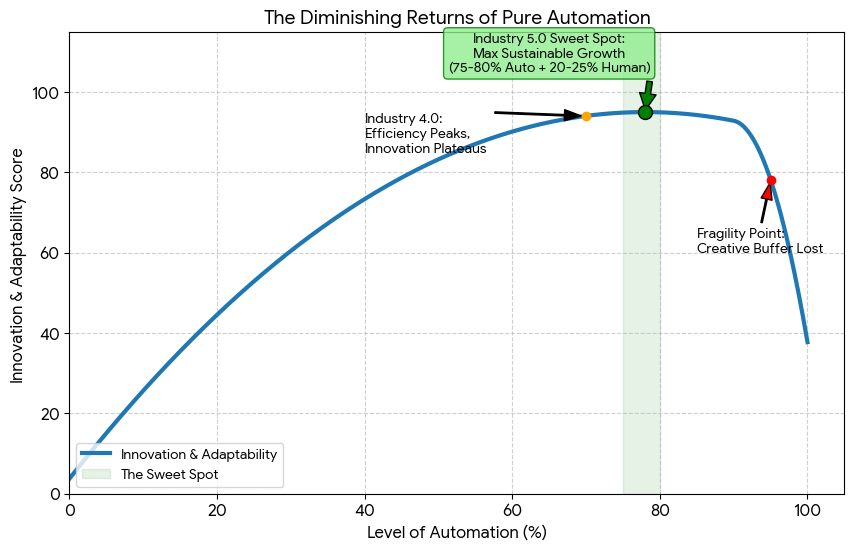
This graph visualises the transition from Industry 4.0 (efficiency-focused) to Industry 5.0 (human-centric), highlighting why total automation can lead to systemic vulnerability.
To achieve commercial excellence, resources will be utilized at a level impacting the global society at a planetary level.
Robots and smart machines are replacing humans at shop-floor by limiting them to on-screen monitoring and performing specific algorithmic tasks making it boring and repeatitive. This culture change has given
This makes humans eventually a minor contributor to the process or maybe even become entirely unneeded at the peak of commercialization of 4.0 technologies.
The question to ponder here is “Are humans not needed as producers and only remain consumers”? Or “ Can Artificial Intellience take over the entire gamut of tasks and eventually replace humans “ ?
To answer this, we need to understand what exactly makes Real Intelligence better than Artificial Intelligence.
The answer lies in one word CREATIVITY !!
As per IIya Sutskever,former Chief scientist and co-founder of Open AI and several experts , who have regularly highlighted the risk of AI training on its own data- called “Model Collapse” or “Digital Dementia” due to lack of original human generated data.
Since AI has already consumed most of the human generated data on the internet, AI is now training itself on AI generated content leading to degradation of quality. This synthetic data is an interpretation of other synthetic data and lacks originality. Despite the risk, companies like Microsoft are training with AI generated data under human supervision.
At the current stage where AI cannot generate original ideas, the need for human creativity is of utmost importance. As per the argument of Matt Fitzpatrick, CEO of Invisible Technologies, synthetic data cannot replace human judgement for decades to come and advocates human supervized learning.
Industry 5.0 brings humans back to the shop floor, with better roles and responsibilities truly suited for real intelligence. In essence, 5.0 model does not remove humans from the process, however they involve humans for the tasks which requires,
- Dynamic thinking.
- Thoughts which have a new origin.
- Design of new philosophies.
- Develop original content.
Apart from developing new thoughts and ideas, humans are also needed in supervisory roles.
In supervisory roles, AI training dataset and content needs scrutiny and ethics management. AI needs guidance and support to develop models which can be used within the limits of its application.
The new technologies of 4th generation are still young and a lot of areas and concepts are theoretically driven rather than a well understood practical approach. In that sense corporations are still experimenting on various models with serious backlashes in competing with each other. Buyouts of startups at a significantly increased evaluation and key resources in industry getting annual packages more than a company’s turnover shows panic and a disintegrated effort.
Industry 5.0 Strategic Readiness Checklist
Assess your organization’s transition from “Pure Automation” (4.0) to “Resilient Value” (5.0).
1. The Cognitive Guardrail (Human-AI Collaboration)
- Model Integrity: Do you have a “Human-in-the-Loop” protocol to audit AI-generated decisions, preventing the “Digital Dementia” caused by synthetic data cycles?
- Skill Augmentation: Are your shop-floor workers being trained as System Orchestrators (managing AI/Robotics) rather than just manual operators?
- Creativity Buffer: Does your production workflow allow for “Creative Intervention” where human intuition can override algorithmic logic during anomalous events?
2. Resource Minimalism & Sustainability (ESG)
- Energy Synchronization: Does your facility utilize “Dark Factory” principles (lights-out manufacturing) to hit net-zero targets without sacrificing oversight?
- Circular Logistics: Is your MES (Manufacturing Execution System) programmed to prioritize Resource Circularity (recycling/reusing materials) over simple volume-based throughput?
- The Green Ledger: Are your sustainability KPIs (carbon footprint per unit) integrated into the same real-time dashboard as your financial CAGR?
3. Resilience & Ethics
- Anti-Fragility: Can your supply chain pivot within 24 hours based on human judgment, or is it locked into rigid, data-heavy 4.0 automation that breaks during “Black Swan” events?
- Algorithmic Ethics: Do you have an Ethics Board or a CoE (Center of Excellence) to ensure AI training data is unbiased and aligns with global governance standards?
- Collaborative IP: Are you participating in Industrial Cooperation (like the Dubuat Engineers network) to share non-competitive data and solve common 5.0 hurdles?
“Industry Maturity Curve”
| Evolution process | Primary focus | Human role | Resource impact | Success metric |
| Industry 4.0 | Commercial Excellence | Monitor (Passive) | High Depletion | Throughput & Volume |
| Industry 5.0 | Systematic Resilience | Orchestrator(Active) | Minimalism/Net Zero | Innovation & ROI |
| Next horizon | Planetary Balance | Integrated Partner | Regenerative | Holistic Well-being |
Core Components of Planetary Balance in Industry 5.0
- Circular Economy & Regeneration: Industry 5.0 aims to move from a linear “take-make-dispose” model to a circular, regenerative approach. This involves reusing, repurposing, and recycling natural resources, as well as reducing waste to minimize ecological footprints.
- Green Innovation & Technologies: The integration of advanced technologies like AI, the Internet of Things (IoT), and digital twins allows for better energy management, resource efficiency, and carbon reduction.
- Bio-Manufacturing: This era embraces smart materials and bio-inspired technologies, fostering a bioeconomy where renewable biological resources are used for production.
- The 6Rs Principle: Industry 5.0 often operates under the 6R framework: Recognition, Reconsideration, Realization, Reduction, Reuse, and Recycling of available resources.
Dubuat Engineers understand the need of holding hands and collaborate to develop a great working solution available to all. Instead of focussing on individual growth, we must understand the need of a collective contribution for smooth transition towards the latest technology. At Dubuat Engineers, we don’t just automate; we augment. Our network of 250+ industrial leaders ensures that your transition to Industry 4.0 includes the ‘5.0 Safeguards’—protecting your organization from model collapse, resource depletion, and the loss of human-driven innovation. We provide the Center of Excellence (CoE) framework to turn individual panic into collective industrial intelligence.
Key Cultural Shifts in industry 5.0,
- From Passive to Active: Humans move from simply watching machines to actively orchestrating complex systems.
- From Volume to Value: Success is no longer just about how much you make, but how much innovation you drive while protecting the planet.
- From Depletion to Minimalism: The model shifts from consuming resources to achieving a net-zero footprint.
Several global leaders have already begun transitioning into the Industry 5.0 “Orchestrator” phase, moving beyond simple automation to focus on human-machine collaboration, systemic resilience, and net-zero goals.
Leading Industry 5.0 Case Studies,
- BMW Group: The automotive giant uses collaborative robots (cobots) to assist workers with heavy lifting and high-precision assembly. This shift allows human employees to act as orchestrators, focusing on problem-solving and design innovation while the machines handle repetitive tasks, resulting in improved assembly efficiency and worker ergonomics.
- Siemens: In its “Factories of the Future,” Siemens integrates Digital Twins and AI to enhance systemic resilience. Human engineers use these virtual models to interpret complex data and make strategic decisions, which has reportedly reduced downtime by 6–8% and costs by 7%.
- DHL: By implementing AI-driven supply chain orchestration, DHL has improved visibility and recall responsiveness. Their transition focuses on a “human-in-the-loop” approach where technology supports human workers in navigating global disruptions, significantly increasing overall operational resilience.
- Toyota: Known for its “Karakuri” (mechanical automation) systems, Toyota emphasizes energy-efficient designs that support sustainable production without relying on energy-intensive solutions. This approach aligns with the Minimalism / Net-Zero resource impact of Industry 5.0 by reducing waste and energy consumption.
- Luxury Fashion (e.g., Designer Brands): High-end fashion sectors are using Industry 5.0 to achieve mass customization. Artisans collaborate with AI and cobots to create unique, personalized pieces, shifting the focus from mass production volume to high-value innovation and customer satisfaction.
Reported Impacts of Transitioning to 5.0,
| Metrics | Industry 4.0 outcomes |
| Productvity | Upto 40% increase in efficiency using human-robot collaboration. |
| Troubleshooting | Accuracy increased upto 90% using conversational AI. |
| Worker Satisfaction | Reported at 83% when operators transitionto higher level orchestrator roles. |
| Waste Reduction | Redundant actions reduced by 66% through worker in-the-loop framework. |
Industry must admit that cooperation will be the key to a successful operation. Instead of competition we must also learn to cooperate in the process of development.
As the saying goes “The ME has to turn WE”!!
